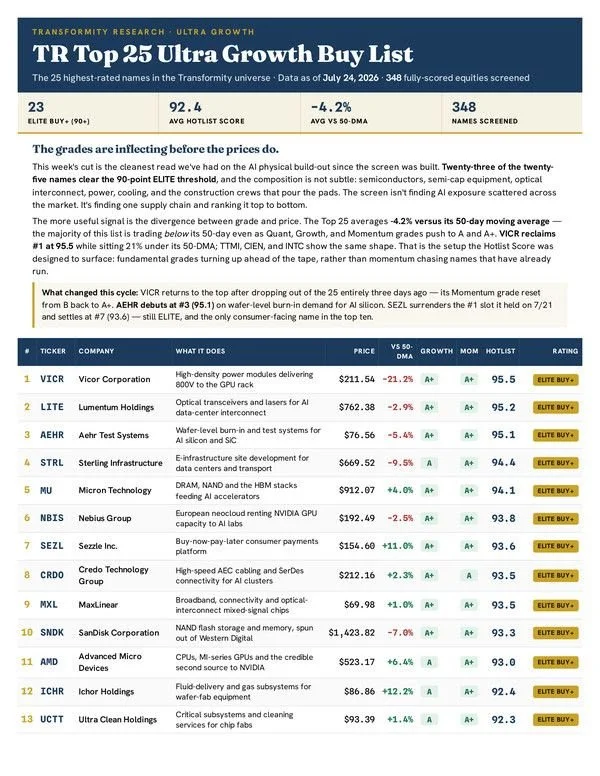
July 2026 Ultra Growth Newsletter Part 1+ Top 25 Ultra Growth Stocks List July 2026
Hey Reader,
In June I wrote "I need you to understand the what and why behind the April to June 9-week parabolic melt-up in our favorite Top 25 Ultra Growth stocks SO THAT YOU ARE PREPARED to
A) navigate these melt-ups and
B) PROTECT your 10 years of profits in 10 WEEKS
C) when the NEXT PARABOLIC melt-up comes to one of our 15 different TR Ultra Growth Sector ecosystems during the $5.7 trillion 2026-2031 global AI data center construction race.
D) But be prepared for the MUCH lower cost AI Frontier models coming out of China that do not require US made CPU or GPU Chips and tokens up to 98% LESS costly.
Key Issue: Here is Bloomberg on the rapid rise of highly competitive much lower price per token AI models.
Chinese startup Moonshot AI released a new artificial-intelligence model on July 17 that drew global attention both for its powerful capabilities and for sending stock markets reeling around the world.
The Beijing-based company’s Kimi K3 AI model delivers performance on industry benchmarks that rivals top-tier offerings from OpenAI and Anthropic PBC, a surprising breakthrough for a firm that has operated in the shadow of local competitor DeepSeek.
AI and semiconductor stocks tumbled on investor concerns that the rise of China’s AI businesses could force US leaders such as Anthropic to pull back on their investments. That could undercut demand at industry powerhouses Nvidia Corp., SK Hynix Inc. and Samsung Electronics Co., whose stock prices fell following the Moonshot news.
Here is the cost analysis from Artificial Analysis for ALL current AI LLMs --and the cost difference of Chinese AI LLMs vs. my favorite Claude AI is stunning
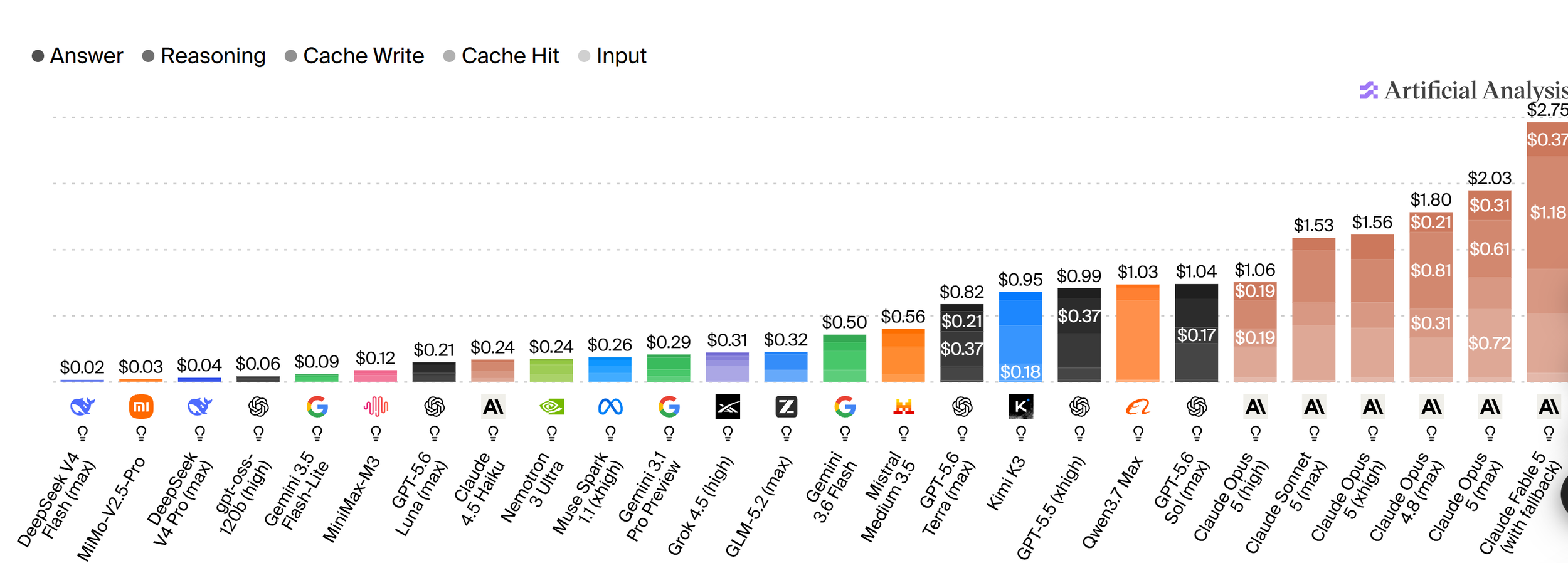
Moonshot AI Makes Waves Despite China's Chip Constraints
Bloomberg reports that Chinese firm Moonshot AI’s Kimi K3 outperforms many rivals on overall capability.
What is Moonshot?
Moonshot was founded in early 2023 by Yang Zhilin, a former Tsinghua University professor who previously worked at Meta Platforms Inc. and Alphabet Inc.’s Google. Before the breakout of DeepSeek, he was the poster boy of Chinese AI. An alumnus of Carnegie Mellon University, Yang has written more than a dozen widely cited research papers on natural language processing. When he set out to launch his own company to challenge OpenAI, venture capitalists rushed to back him. MoonShot AI’s valuation soon reached $20 billion as Kimi became China’s most popular ChatGPT alternative.
Read More: China’s Moonshot Unveils AI Model, Fueling Tech Rout
What is Moonshot’s business model?
Moonshot is looking to raise as much as $2 billion in new funding at a valuation of $30 billion, Bloomberg reported in June, putting it among the leaders in China’s AI market. The Kimi developer is in the process of dismantling its offshore structure to pave the way for an initial public offering in Hong Kong, after Beijing tightened its grip on overseas listings.
The company’s annual recurring revenue — a gauge of its forward-looking sales — topped $200 million in April, driven by surging demand for its chatbot and large language models. The company sells tiered subscription plans for the chatbot and offers its underlying technology to enterprise clients.
What threat does Moonshot pose to US rivals?
Moonshot claims that the latest version of Kimi excels at coding tasks. US firms are spending hundreds of billions of dollars on AI infrastructure to run and improve their models — much of it going to chipmakers. Coding is one of the most lucrative offerings by advanced model companies, driving revenue for Anthropic and OpenAI ahead of their planned IPOs.
Chinese models have already priced their services aggressively, undercutting US rivals. The weighted average cost of performing a standardized intelligence task using Kimi 2.6 or DeepSeek’s V4 Flash model ranges from 33 cents to just 2 cents, compared with $2.75 for the same task on Anthropic’s Claude Fable 5, according to benchmarking site Artificial Analysis.
Are Chinese AI companies playing fair?
There’s the possibility that Kimi and others in China have already benefited from Anthropic’s work and investment. Earlier this year, Anthropic accused Moonshot, DeepSeek and MiniMax of training their models based on Claude’s capabilities, in a process known as distillation, with “industrial-scale campaigns” that are “in violation of our terms of service and regional access,” according to a February blog post. Moonshot didn’t respond for a request for comment regarding Anthropic’s accusations.
In its latest release, Moonshot positioned itself as an underdog. “Despite being a highly competitive model overall, K3 nonetheless exhibits a noticeable gap in user experience compared with Claude Fable 5 and GPT 5.6 Sol.”
Key Point: Our managed accounts (except for Ultra Monthly Income accounts 80% invested ) are 60% in ULTRA SAFE low volatility high yield ETFs riding out the now growing uncertainty in the Global AI Data Center build out given the new AI models out from China this week.
Moonshot AI’s surprise release of a new artificial intelligence model has sent a jolt through markets, forcing investors to reassess some of the biggest assumptions behind the global tech rally.
The Chinese startup unveiled Kimi K3 on Friday, a model that it says delivers performance that rivals top-tier offerings from OpenAI and Anthropic PBC at a fraction of the cost. As investors drew comparisons with last year’s “DeepSeek moment,” IG market analyst Tony Sycamore said $314 billion has been wiped from the company’s valuation estimates for the two unlisted US firms.
The debut challenges the view that US curbs on advanced chip exports would hamper China’s AI progress. It also raises questions about whether cheaper, more capable models could lead to overcapacity in AI infrastructure while accelerating adoption worldwide.
Here’s a look at some of the potential winners and losers.
Explainer: What Is Moonshot AI and Why Is It Roiling Markets?
WINNERS
Local Semi Ecosystem
While it remains unclear what chips Moonshot used to develop the K3 model, the launch has given Chinese semiconductor stocks a boost. Shares of local chipmakers climbed on Monday, with Semiconductor Manufacturing International Corp. rising as much as 5.4% in Shanghai on expectations that rising competition among AI model developers will drive more spending on related infrastructure.
“We expect the biggest winners to remain the AI infrastructure layer,” said Gary Tan, a portfolio manager at Allspring Global Investments.
“Backed by strong government support, China’s push for open-source AI is likely to accelerate the deployment of state-of-the-art China domestic models, which will require greater computing resources and drive demand for the underlying hardware, particularly networking and memory,” Tan added.
AI Agents & Software
The launch also bolsters confidence that Chinese software firms and AI agentic developers can continue to improve performance and efficiency even with limited access to the world’s most advanced chips.
“What we do know is that a capable, cheaper open model lowers the cost of building applications and could accelerate adoption across coding, customer service and industrial workflows,” said Charu Chanana, chief investment strategist at Saxo Markets.
Still, Morningstar Inc. analyst Malik Ahmed Khan said that Friday’s selloff in Alphabet Inc., Amazon.com Inc. and Microsoft Corp. driven by concerns that more firms will switch to open-source models inspired by K3, was “misplaced.”
“We do not believe that US enterprises, government agencies, or companies that work with the US government will adopt Chinese open-weight models to save on inference costs,” he added.
READ: GLOBAL REACT: China’s Moonshot Brings US AI Down to Earth (1)
Memory Chip Makers
K3’s scale at 2.8 trillion parameters and a one-million-token context window requires far more memory capacity than earlier generations, indicating sustained demand for an area where supply remains dominated by only a handful of suppliers, such as South Korea’s SK Hynix Inc. and Samsung Electronics Co.
Memory makers should still be in the best position among semiconductor names, given the limited number of suppliers, said Stanley Tang, senior portfolio manager at Sumitomo Mitsui DS Asset Management. Overall demand is unlikely to be reduced if models like Kimi become more popular as that could accelerate the penetration of agentic AI, he added.
LOSERS
AI Model Developers
If K3 has created new winners, it has also made the race among developers more challenging.
Shares of Z.AI Co., better known as Zhipu and seen as China’s best open-source model developer before K3’s debut, have plunged almost 40% in Hong Kong over the past two trading sessions.
The competition is unlikely to ease from here. Alibaba Group Holding Ltd. shares rose on Monday after the company launched a preview of its flagship Qwen3.8 Max model, describing it as second only to Anthropic’s Fable 5. MiniMax Group Inc. is also expected to unveil an updated version of its M3 model.
“We are still at an early stage and there is always a better model coming out,” said Sumitomo’s Tang. “Some of the models could become worthless and I think the market is still yet to fully consider this risk.”
High-End Chipmakers
Moonshot has also raised questions about whether the biggest beneficiaries of the AI boom — such as Nvidia Corp. and Advanced Micro Devices Inc. — can continue to command a scarcity premium.
“Investors in Tokyo and Taipei spent the day pricing in doubt about whether AI capex will ever pay off,” said Mark Malek, chief investment officer at Siebert Financial. “Every time a lab anywhere in the world – doesn’t matter which flag it flies – ships a frontier-grade model for free, that assumption takes another hit.”
Much more to come on Monday--including our expansion to more secular growth sectors --but we needed to get this new generative AI model news out PRONTO!
Feel free to share this with your fellow investor friends--this is just first round of China AI models versus the world--
Toby