How To Navigate the NEXT Parabolic Melt-UP Mania In TR Ultra Growth Stocks + ETFs
Well, kids-- as we wait for the LITERAL lift off of the now $2.1 TRILLION SpaceX IPO tomorrow morning (DO NOT put a market order in at the open--the stock will take up to an hour to "open"--look at a chart of CBRS IPO last month!), I want to make VERY sure you understand the how and why the US stock market for our secular growth stock ecosystems AI Data Center Technology + Structural Optical & Cooling Infrastructure + AI Building Materials + Power Grid Construction + BYOP aka "Bring Your OWN Power Generation BEHIND the Meter technology solution + Power Utilities' & SMR nuclear power stocks turned into a 9 week orgy of computer algorithmic trading momentum where our Top 25 Ultra Growth stocks moved up over 110% in just nine weeks!
I need you to understand the what and why behind the 9-week parabolic melt-up in our favorite Top 25 Ultra Growth stocks SO THAT YOU ARE PREPARED and know how to navigate these melt-ups and PROTECT your 10 years of profits in 10 WEEKS when the NEXT PARABOLIC melt-up comes to our 15 different TR Ultra Growth Sector ecosystems--because I guarantee we will have another $trillion algorithmic trading bot parabolic move many times during the $5.7 trillion 2026-2031 global AI data center construction race.
How can I be so sure of more melt-ups and meltdown corrections in our favorite hyper-growth sector ecosystems? Let me be the one to share this little secret--analysts like my team of experts and me have lived and invested in MANY stock sector meltups--but today there is some market math you MUST understand. So here we go!
What YOU NEED TO KNOW About Trading Stocks in Stock Sector Manias When An ENTIRE SECTOR rockets higher in a Straight Up 100%+ Parabolic Valuation in 60 days or less!
First--the locked-in global AI bottleneck $5.7 trillion spend 2026 2031 became the SURE THING NO-BRAINER SECULAR GROWTH trade after Trump’s invasion of Iran—because with DJT the only certainty is UNcertain except that 20% of global oil can’t get to the world’s largest buyers of imported oil.
Second, because of the daily uncertainty about the execution of the Iran “excursion” --the $5.7 TRILLION Infrastructure spend 2026-2031 became the SURE THING 2026 TRADE with fundamental investment managers and retail investors in early March 2026, when 25 AI Data Center tech stocks accounted for nearly 50% of the S&P 500 market cap.
But that “sure thing” fundamental upward price momentum is like crack cocaine to algorithmic Algo trading bots--and--after a small correction….from April 2 this year- AI Data Center tech stock investors got 9 WEEKS of higher highs primarily in our Top 25 AI Technology bottleneck stocks that we shared with you first in April—from the HBM NAND Hard Drive memory and Co-Packaged Optical networking components—and the explosive transition to INFERENCE AI from LLM AI training crated huge demand for CPUs TPUs and ASIC chips made from Google/Microsoft/Amazon which was great for Broadcom, TSM, Marvel etc.
But like EVERY STOCK SECTOR mania, especially new global secular technology transformations--from Cisco/Sun Microsystems/AOL etc in the Internet Stock mania 1995-2000 to today--the “momentum trade” gets supercharged by the NEW MARGINAL STOCK BUYERS -- the computer-based algorithmic stock traders who are NOT PRICE OR VALUE SENSITIVE!!.
Note: Estimates suggest that pure quantitative and multi-strategy momentum-based funds command roughly $1.5 trillion to $2 trillion in total AUM globally, with the vast majority heavily active in the highly liquid U.S. stock market. AND with the sharp upward price momentum starting in April—50 day moving average through the100 day—then 50 day through 20-day —we got an 124% average stock price gain in just 9 WEEKS April 2 to June 2--and THAT MEANS a new marginal buyer aka price/value insensitive buyer arrived on the scene—the algorithmic trading bots--aka the Algo Bots!
Super Key Point: In the 9-week parabolic meltup we just had in the US stock market, it is ALWAYS the price-insensitive, computer-driven momentum algorithm bots running the meltup show — and from April 2 to June 4, Algorithmic Trading Bots bought over 70% of AI data center stocks with MARKET ORDERS—like EVERY day!
Definition Check: In any market for anything from art to stocks, the “marginal buyer” is the price/value-insensitive buyer. In stocks, the marginal buyers are A) new money going into Index Funds, and B) new money going into actively managed long only funds that can only hold X amount of cash, but MOST IMPORTANT, the marginal buyer of the last 9-10 weeks has been the price-insensitive computer algorithm funds.
Key Context: The AVERAGE annual return for the S&P 500 index of stocks over the last 25 years includes two of the worst market crashes in modern history—the dot-com bubble burst (2000–2002) and the Great Recession (2008)—but is offset by the subsequent massive bull markets.
Total Average Annual SP 500 Return (with dividends): ~8.5%
Total Return of our Top 10 “Age of AI Inference” Data Center Infrastructure Stocks April 2 to June 2, 2026--124%
How Many YEARS of Wealth Did Our Top 10 Age of AI Inference stocks gain in just 9 weeks???
14.5 Years of stock market gains in just 9 weeks!
It was only a matter of time that SOME earnings print from a major AI Data Center technology leader would crash the 9-week algo party. . . and that was the Broadcom earnings announcement—AVGO was priced for perfection with MASSIVE expectations for their June 4 Q2 announcement of RISING demand—that did not happen.
Management held their 2026 forecast but did not boost their Q3 guidance, prompting fundamental owners to take profits and setting off a cascade of market SELL orders from the momo bots as the 10-day line dropped below the 20-day line, etc., etc., etc. Also contributing to the liquidation momentum was the liquidation of 2-3X-leveraged AI Bottleneck Breaker ETFs with sell stops.
When does the AI Bottleneck Breakers stock selling end? Answer is —when fundamental institutional money “buys the dip.”
And that is what happened last week and today--"fundamental LONG-term investors and investment funds stepped in because they saw REAL VALUE in the companies leading the $5.7 trillion global AI Data Center buildout. Yet at the same time, Oracle came out with amazing data center growth but announced they wuld be selling new stock and borrowing
Your Algorithmic Trading Explainer Course 101
We just experienced an AI Data Center Infrastructure tech stock momentum "meltup" that lasted 9 weeks—that was fun and profitable IF you had meaningful positions in our TR Top 25 stocks, the ALGORITHMIC TRADING BOTS were trading them with market orders long and nonstop... until the self-fulfilling momentum party stopped.
THUS—if you are fortunate enough to be in an other algo momentum meltup—USE friggin 10% Moving SELL STOPS and enjoy the ride but know that ALL ALGO DRIVEN STOCK SECTOR MELTUPS END eventually—and the same buying volume gets matched with the same SELLING volume—that is how momentum algorithmic trading works—as hundreds of hedge funds with many $TRILLIONS in AUM play that strategy—especially those who have non-taxable fund investors.
What you REALLY need to understand is that in 2026, Financial analysts, exchanges, and regulatory bodies estimate that algorithmic trading accounts for roughly 60% to 73% of DAILY US equity trading volume.
Key Point: Here is your homework assignment for the weekend--UNDERSTANDING How and Why Algorithmic Trading in 2026 is 65-70%+ of ALL TRADES . . .so here is what to do if you have stocks or ETFs caught up in "The AI ALGO Momentum Zone!"
Quick Course on Algorithmic Trading Technology & How The “Algo Funds” work
Momentum-based algorithmic stock trading is a subset of quantitative trading that uses computer programs to automatically buy assets that are rising in price and sell those that are falling. It is rooted in the market anomaly that trends tend to persist over the short- to medium-term. Instead of trying to buy a stock at its absolute bottom or find its fundamental "intrinsic value," momentum algorithms operate on a simple philosophy: "Buy high, sell higher."
How Much Money is in Algorithmic Hedge Funds?
U.S. hedge fund assets under management (AUM) sit at over $5 trillion. However, pinpointing the exact percentage controlled strictly by "algorithmic funds" is nuanced, as the line between traditional and automated investing has significantly blurred. The industry capital is broadly structured across these categories: Pure Quantitative & "Black-Box" Funds. Pure-play quantitative firms (such as Renaissance Technologies, Citadel, Two Sigma, and D.E. Shaw) rely almost exclusively on algorithmic frameworks to manage their portfolios--and they run over $2 trillion in OPM ("other peoples money).
Estimates suggest that pure quantitative and multi-strategy funds command roughly $1.5 trillion to $2 trillion in total AUM globally, with the vast majority heavily active in the highly liquid U.S. stock market. With the rise of highly leveraged (2-3X) Systematic & "Quantamental" trading, pure discretionary (human-only) hedge funds are increasingly rare. Market reports indicate that roughly 70% to 80% of all daily trades are “Algo Fund Trades.”
Thus--here is a Quick Course on Algorithmic Trading Technology & How The "Algo Funds" work that you NEED TO UNDERSTAND!
1. How Algorithmic Stock Trading Works
Momentum-based algorithmic stock trading is a subset of quantitative trading that uses computer programs to automatically buy assets that are rising in price and sell those that are falling.
It is rooted in the market anomaly that trends tend to persist over the short- to medium-term. Instead of trying to buy a stock at its absolute bottom or find its fundamental "intrinsic value," momentum algorithms operate on a simple philosophy: "Buy high, sell higher."
Algorithmic trading strips human emotion and manual execution out of the investment process. It operates through a structured pipeline:
Data Ingestion: Computers ingest massive, real-time data feeds, including price data, order book depth, macroeconomic news, and even social media sentiment.
Rule Evaluation: The system evaluates this data against pre-programmed rules. For example, a momentum algorithm might look for a rule like: “If a stock's price crosses above its 50-day moving average on 1.5x average volume, issue a buy order.”
Automated Execution: The algorithm slices large orders into hundreds of smaller, optimized orders to avoid altering the market price, executing them in milliseconds across various exchanges.
2. Why It Works (The Core Mechanics)
Algorithmic trading is highly effective because it exploits specific institutional advantages and structural market behavioral patterns:
Speed and Efficiency: Algorithms capitalize on price discrepancies or micro-trends in milliseconds—far faster than any human trader can click a mouse.
Exploitation of Behavioral Bias: Human investors suffer from cognitive biases (like overreacting to news or holding onto losing stocks too long). Algorithmic trading exploits these predictable behavioral patterns.
Removing Emotional Discipline Risk: A computer never suffers from FOMO (Fear of Missing Out), panic, or greed; it strictly adheres to risk management parameters, such as the 10% moving sell stops mentioned above.
3. How Algorithmic Trading Volume is Estimated
Financial analysts, exchanges, and regulatory bodies estimate that algorithmic trading accounts for roughly 60% to 73% of daily US equity trading volume using several highly precise metrics:
Message-to-Trade Ratios: Algorithms routinely place, cancel, and modify thousands of orders a second to test market depth or hide their true intentions. A massive spike in the "message-to-trade" ratio (where hundreds of order adjustments occur for every executed trade) is a definitive sign of algorithmic activity.
Institutional Order Routing Patterns: Large hedge funds use standardized execution algorithms (such as VWAP—Volume Weighted Average Price or TWAP—Time Weighted Average Price). Because these algorithms slice a multi-million-share order into perfectly timed, predictable increments throughout the trading day, analysts can easily reverse-engineer the volume data to identify algorithmic footprints.
Execution Speed (The Millisecond Signature): When news drops or a specific price floor breaks, and millions of shares change hands within microseconds, it is physically impossible to be human activity. Looking at trade timestamps down to the nanosecond allows exchanges to isolate high-frequency trading (HFT) and algorithmic volume from retail or traditional manual institutional orders.
Dark Pool and Block Trade Tracking
Many hedge funds execute their trades in "Dark Pools" (private forums for trading securities) to prevent public markets from moving against them. By analyzing the reporting feeds from these venues, quantitative analysts can calculate the baseline flow of institutional algorithmic capital moving through the market.
4. Main Mathematical Models Used by Trading Algorithms
Hedge funds and quantitative firms use rigorous mathematical frameworks to automatically calculate entry points, exit thresholds, and exposure parameters.
A. Time-Series and Trend-Following Models
ARIMA (Autoregressive Integrated Moving Average): A statistical model used to predict future trends by looking at linear dependencies in historical price logs, stripping out baseline seasonality (differencing), and factoring in historical residual errors.
EMA Crossover (Exponential Moving Average): Applies a weighted multiplier to prioritize recent price actions over older data. When short-term trend averages cross long-term averages, orders trigger instantly.
B. Mean Reversion and Structural Models
Z-Score and Bollinger Bands: Measures how many standard deviations a stock's immediate price sits away from its rolling mean. If a stock expands past statistical thresholds (e.g., a Z-score of $\pm 2.0$), the algorithm places a trade expecting the price to snap back to its historical average.
Co-integration (Pairs Trading): Monitors historically linked assets (like two major energy or tech stocks). When the historical price spread between them widens beyond standard statistical tolerances, the bot shorts the overperformer and buys the underperformer, capturing a spread correction.
C. Advanced Risk & Portfolio Optimization
The Kelly Criterion: Dynamically resizes position exposure based on the algorithm's historical win rate and net payout odds, mathematically ensuring the capital pool scales up during favorable market regimes without risking absolute ruin.
Mean-Variance Optimization: Uses quadratic equations along the Markowitz Efficient Frontier to continuously shift portfolio weights, maximizing expected yield while keeping portfolio volatility strictly constrained.
LOL you got all that right??? Now I hope you understand Tobin’s Trading Law 101--When you are lucky enough to have stock or ETFs that are streaking up in value MUCH FASTER than the overall SP 500 is--YOUR STOCK OR ETF IS IN THE MOMENTUM ZONE, and you MUST USE 10% trailing sell stops which is 100% required to bail on those positions WHEN THE ALGOS DO!
In fact--after 10 trading days in a sector or stock/ETF meltup run, I go to a 5% market sell stop--following the most famous and enduring maxims on Wall Street:
"Bulls make money, bears make money, pigs get slaughtered."
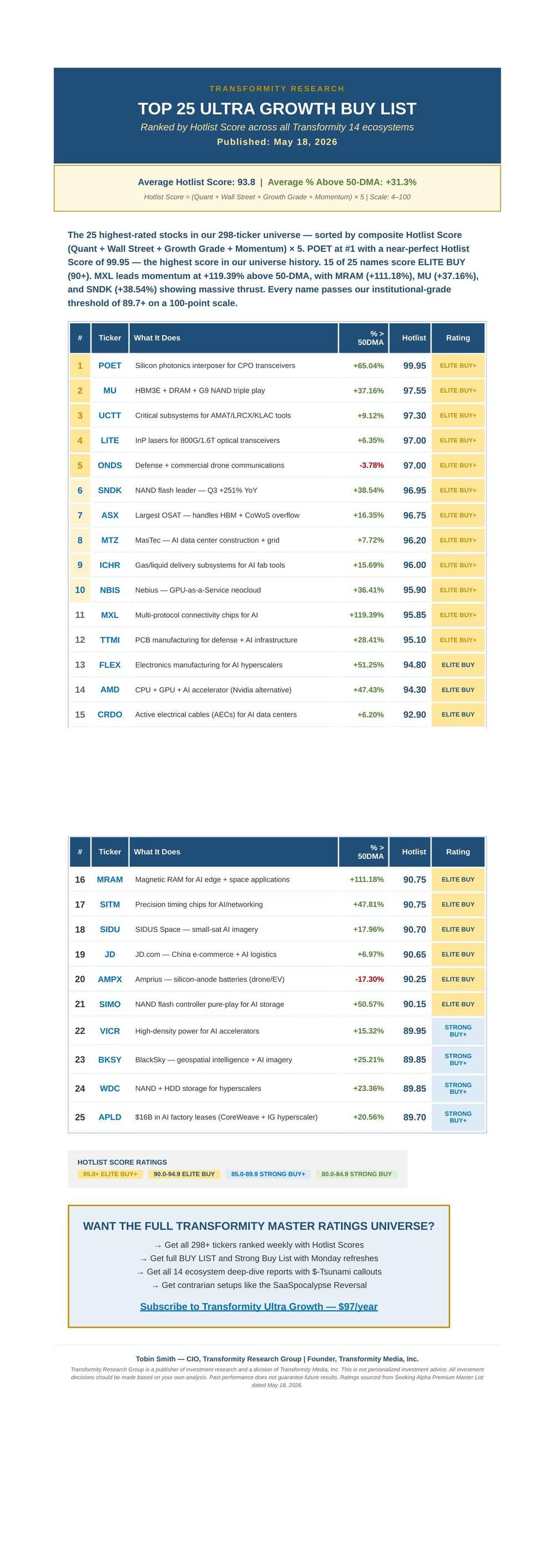
Class dismissed! Here is our latest TR Top 25 Buy List--it was up 44% this week!!!
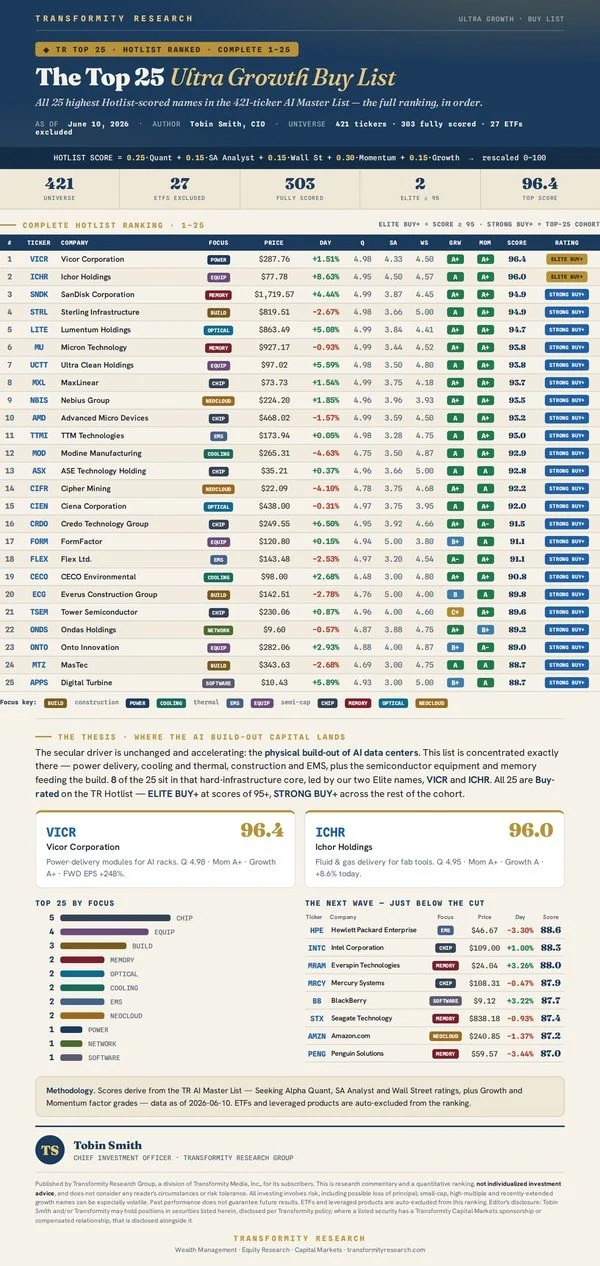
Which is great for us, investing in the global UNSTOPPABLE 5 YEAR $5.7 trillion AI infrastructure build-out--with PROVEN rising cash flows in most cases
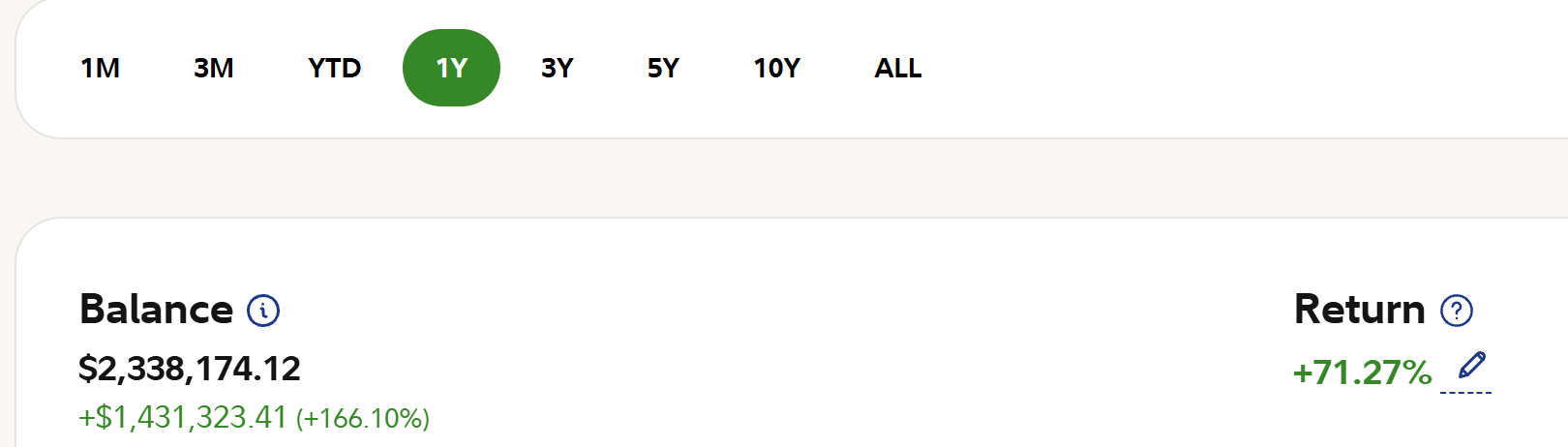
As both our subscribers and a growing number of wealth management clients (minimum account is $500,000)--thanks to the last 4 AI Stock Meltdowns--the average annual TR Wealth Management Ultra Growth portfolio value growth 2024-2025 has been 84.5% per year, and May 25 2026 is already at 71%!
NOTE: IF you are interested in opening a TR Ultra Growth Wealth Management account ($500,000 minimum--IRAs fine!), we have openings for just 10 MORE clients-- contact Marjorie Sutherland-Smith at msmith6116@gmailcom or text 301 520-9610
How We Are Building REAL Wealth Investing in the Age of AI Inference Revolution 2.0 2026-2031
As we reported to you last week in your May 2026 newsletter--the global landscape for AI infrastructure has INDEED shifted rapidly, and estimates for inferential capacity and general AI development for 2026-2031 have reached astronomical levels.
The good news for your wealth is that the VALUATIONS of the ENTIRE building blocks that drive Inferential AI Revolution 2.0 are getting RE-RATED because MANY of the key enabling technologies involved in Inferential AI 2.0 are SOLD OUT till 2027 and many to 2028!
Remember--the very latest estimated global cost of the build-out of the Age of Inference AI revolution is as follows:
The "HISTORIC $$Global AI Infrastructure Spend Numbers" for 2026-2031
Let me be clear: the total global capital expenditure (CapEx) for AI infrastructure is no longer measured in billions, but is rapidly approaching the $TRILLION ANNUAL mark.
Category 2026 Estimate 2030-2031 Projection Annual Global AI CapEx $765 Billion $1.6 Trillion Top 5 Tech Giants (Combined) $660 – $690 Billion — Cumulative Global Investment $5.2 – $7.6 Trillion Global AI Infrastructure Market $142.8 Billion $947 Billion (by 2035)
Breakdown of Development Costs
The "cost" of development isn't, of course, just about the chips (GPUs/TPUs/APUs/CPUs); it's about the entire physical and digital stack required to run models in answer production mode (aka AI "inference").
Hyperscaler Dominance: The "Big Five" (Amazon, Alphabet, Microsoft, Meta, and Oracle) are the primary drivers. Amazon alone is projected to spend $200 billion in 2026, followed closely by Alphabet at $185 billion.
The Shift to Inference: While 2023–2025 was defined by "Training" costs, Inference AI will account for 55%-80% of all enterprise spending in 2026 and beyond
The Infrastructure "Tax": Roughly 25% ($1.3 trillion) of the total long-term investment is being funneled into metered and onsite power, cooling (liquid immersion), and electrical grid upgrades, which have become the primary bottlenecks.
Key Cost Drivers in 2026
Hardware Hardware (51.7% of spend): Includes the massive 2026 rollout of VERA RUBIN (B200), built around a new "superchip architecture " that started production in H2 2026, and custom ASICs (TPUs, APUs, Trainium, Inferentia).
Power & Grid Upgrades: Data center power demand is projected to rise 165% by 2030, requiring roughly $720 billion in global grid upgrades just to keep the lights on.
Sovereign AI: Governments (EU, Saudi Arabia, Japan, India) have committed over $84 billion to build nationalized AI infrastructure to ensure data sovereignty.
1. The Total Breakdown of the $5.2 Trillion AI Investment 2026-2031
According to the latest 2026 industry outlooks, total spending is segmented into three primary categories:
Technology & IT Equipment ($3.1 Trillion / 60%): Spend on AI chips (GPUs/TPUs/APUs), high-performance networking, and advanced storage. This reflects the "fit-out" phase of new builds.
Energy & Power Infrastructure ($1.3 Trillion / 25%): Covers the "Energizers"—on-site power generation (turbines, fuel cells), power transmission, cooling systems, and electrical transformers.
Real Estate & Core Construction ($800 Billion / 15%): Land acquisition, physical building materials, and site development for greenfield projects.
2. On-Site Power: The New "Gating Factor."
With global data center occupancy at a record 97%, the primary bottleneck is no longer land or capital, but time-to-power.
GE Vernova (Gas Turbines): Data center orders for GE Vernova reached $2.4 billion in Q1 2026 alone, surpassing its total orders for all of 2025. Their gas turbines are being deployed as bridge power for gigawatt-scale campuses that cannot wait for grid connections. They are sold out till 2028.
Bloom Energy (Fuel Cells): Bloom Energy reports that 73% of operators are now embedding on-site power into their long-term strategies. Their solid-oxide fuel cell servers are increasingly used for "behind-the-meter" generation to provide high-density power for AI racks.
Capacity Surge: Approximately 100 GW of new data center capacity is expected to be added between 2026 and 2030, doubling global capacity. For context, JLL Research estimates that 100 GW of new supply requires roughly $3 trillion in direct investment, excluding high-end IT fit-outs.
3. Regional and Strategic Shifts
Hyperscale Dominance: The "Big 4" (Amazon, Google, Meta, Microsoft) are projected to invest over $400 billion in 2026 alone.
Inference vs. Training: A major pivot is expected in 2027, when Inference workloads are projected to overtake training as the primary driver of data center demand, requiring different power and cooling architectures.
Cost of Build: Construction costs are rising at a 7% CAGR, with JLL forecasting average costs to hit $11.3 million per megawatt (MW) by late 2026.
Summary Table: Age of Inference AI Investment Forecast (2026-2030)
Category Spend Estimate Key Beneficiaries IT Hardware $3.1 Trillion NVIDIA, AMD, Custom TPU Manufacturers Power Systems $1.3 Trillion GE Vernova (Turbines), Bloom Energy (Fuel Cells), Micron (HBM) Construction $800 Billion Equinix, Digital Realty, Specialized EPC Firms Total $5.2 Trillion
The Age of Inference AI Revolution 2.0 Portfolio
This year, with the logarithmic 800X explosion of Claude AI users and $90 BILLION revenue forecast in 2027 (and if you are in white-collar knowledge work and do NOT use Claude AI every day--your job is in serious jeopardy), we have hit a crucial pivot point in the AI market: the shift from the "Build" phase to the "Value" aka mass productivity revolution phase.
Key Point: All of $trillions in inferential AI capacity DID NOT happen in a vacuum.
AI models, especially Anthropic's newest versions of Claude, coupled with OpenClaw—software for creating AI agents—have made AI’s capabilities incredibly clear and are being massively adopted worldwide (PS I use ClaudeAI/OpenClaw and Gemini EVERY DAY).
What’s also become clear is that AI agents —and AI Inference's insane use case demand for $Trillions in more computing power—are NOT likely to slow down in the next 5 years — they're actually speeding up!
What I am really saying here is that ultimately, what matters for you and me as investors in the Age of Inference AI is the DEMAND GROWTH RATE for Inference & Agentic AI IS UNSTOPPABLE in the same way getting a PC on every work desk/home/school etc was with the birth of the PC--the Internet--and the smart phone.
Here's your LINK to our 13 (soon to be 15) deep research into the entire Age of Inferential + Agentic AI ecosystems of public (and private ones on an IPO path):
https://www.transformityresearch.com/reports
Action To Take- Build Your Age of Inference AI Portfolio 1/3, 1/3, 1/3